SMPS Webinar
Beyond AI: The People-First Strategy Your AEC Firm Needs to Win Work Smarter

ZOOM

Apr 25, 2024

10:30 AM (PT)
Register Now


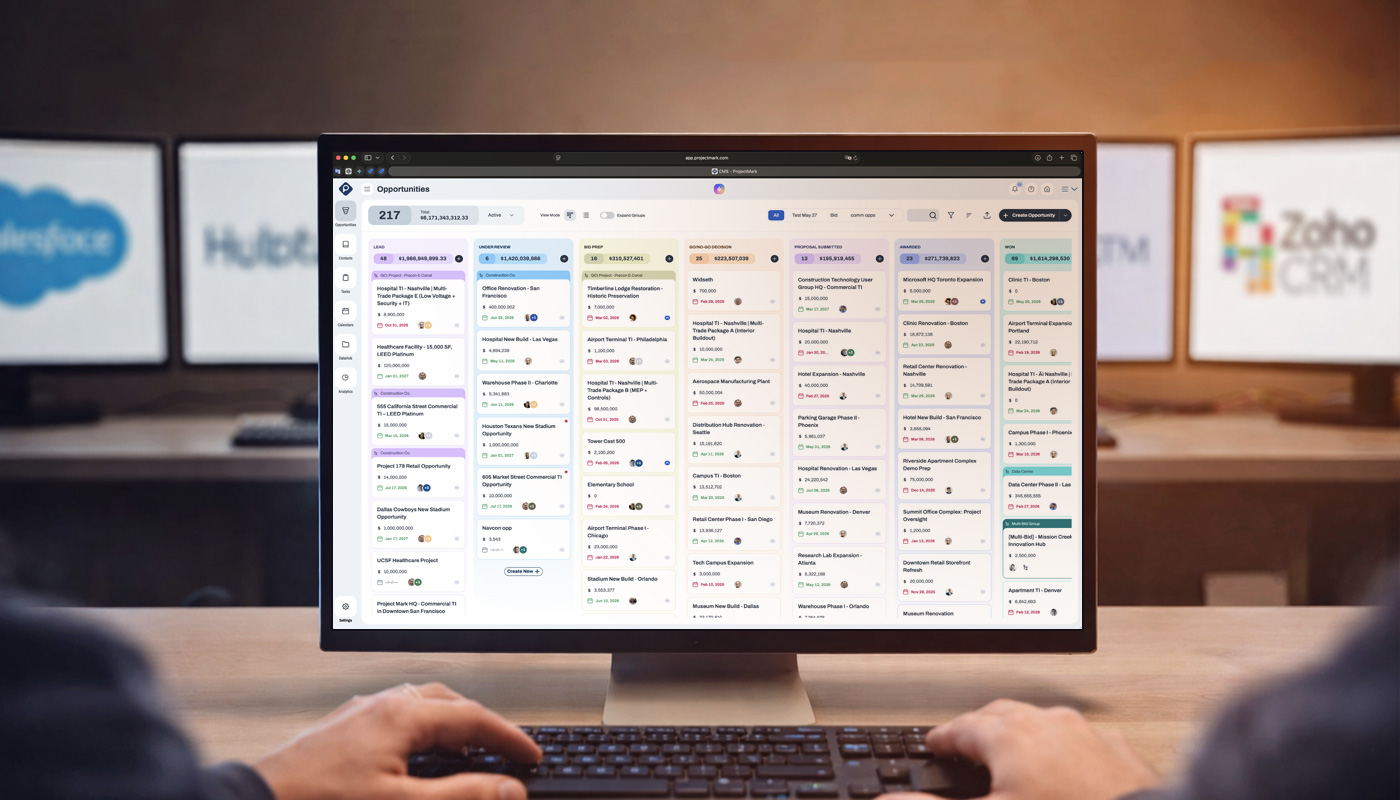
The Architecture,Engineering, and Construction (AEC) industry is currently navigating a periodof profound digital transformation. For decades, the sector relied uponfragmented communication methods, ranging from physical ledgers to disconnectedspreadsheets. However, as project complexities increase and profit marginsremain under constant pressure, the necessity for sophisticated team alignmentand collaboration tools has become undeniable. It is no longer sufficient tomerely track leads; a modern firm must harmonize its entire lifecycle, from theinitial pursuit to the final closeout.
In this landscape,many organizations find themselves at a crossroads. They must choose betweengeneralist Customer Relationship Management (CRM) platforms, which are designedto serve a broad spectrum of industries, and specialized solutions like ProjectMark, which are engineeredspecifically for the nuances of the construction environment. This analysisseeks to explore the critical differences between these approaches, focusing onhow ProjectMark addresses the uniquefriction points that often hinder construction firms from achieving their fullpotential.
One mustacknowledge that the implementation of any new software is a significantundertaking that requires a commitment of time, capital, and culturaladaptation. Therefore, it is prudent to evaluate these tools not only on theirtechnical specifications but also on their ability to foster genuineaccountability and increase win rates within the specific context of the AECsector.
One of the mostpersistent challenges in the construction industry is the disconnect betweenthe preconstruction phase and the commencement of operations. It is a commonobservation that valuable information gathered during the bidding process isfrequently lost or obscured when a project transitions to the execution team.This fragmentation often leads to misaligned expectations, budget overruns, andstrained client relationships.
Generalistcommunication tools often fail to bridge this gap because they lack thestructural framework necessary to carry project-specific data through variousstages of the project lifecycle. When a sales team utilizes a generic CRM, thedata captured is often focused on transactional milestones rather than thetechnical requirements and historical context that an operations team requires.
In contrast, ProjectMark is designed with theunderstanding that a successful project is a continuous narrative. By providinga centralized platform where preconstruction data is seamlessly accessible tooperations personnel, ProjectMarkensures that the original intent of the bid is preserved. This level ofalignment is essential for maintaining the integrity of the project scheduleand budget. When every stakeholder has access to a single source of truth, thelikelihood of errors resulting from miscommunication is significantly reduced.
Generalist CRMs,such as Salesforce or HubSpot, are undeniably powerful engines of datamanagement. They offer a vast array of features that can be customized to suitalmost any business model. However, for many construction firms, thisversatility comes at a high cost, which one might describe as a"complexity tax."
Because theseplatforms are built to serve industries as diverse as retail, healthcare, andsoftware-as-a-service (SaaS), they require extensive customization to meet thespecific needs of the AEC industry. A firm must often hire specializedconsultants to build custom objects, workflows, and reporting structures thatreflect the realities of construction bidding and project management. Thisprocess is not only expensive but also time-consuming, often leading to aprolonged implementation period that can frustrate staff and delay therealization of value.
ProjectMark offers arefined alternative by providing a platform that is inherently aligned withconstruction workflows from the moment of deployment. Rather than forcing afirm to adapt its processes to fit a generic software structure, ProjectMark reflects the existinglanguage and logic of the AEC industry.
For example, whilea generalist CRM might focus on "leads" and "deals," ProjectMark understands the importanceof "pursuits," "bids," and "project portfolios."This alignment of terminology and structure reduces the cognitive load onusers, making it more likely that both field and office teams will engage withthe software consistently. It is a well-documented phenomenon that the successof any software implementation is directly tied to user adoption; by offeringan intuitive interface that speaks the language of construction, ProjectMark facilitates a higher levelof engagement across the organization.
A common tensionin software development is the balance between ease of use and the depth ofdata tracking. Many firms fear that a tool which is simple enough for daily usewill lack the analytical power required for strategic decision-making.Conversely, they worry that a robust data engine will be too cumbersome fortheir teams to navigate.
ProjectMark addresses thistension by offering a sophisticated user experience that does not sacrificedata integrity. The platform is designed to capture high-level intelligencewithout requiring exhaustive manual entry. By automating many of thedata-gathering processes and providing clear, visual representations of theproject pipeline, ProjectMark allowsexecutives to gain a comprehensive understanding of their firm's performancewithout overwhelming the staff responsible for data entry.
It is prudent toconsider that in the construction industry, time is a finite and preciousresource. Every hour spent navigating a complex software interface is an hourtaken away from project delivery or business development. ProjectMark recognizes this reality by streamlining workflows,ensuring that the most critical information is always at the user's fingertips.This focus on simplicity ensures that the data remains accurate and up-to-date,which is the foundation of any successful win-rate optimization strategy.
Increasing afirm's win rate is not merely a matter of submitting more bids; it is a matterof submitting the right bids. Toachieve this, a firm must have a deep understanding of its historicalperformance, its competitive advantages, and the specific requirements of eachopportunity.
Generalist toolsoften struggle to provide this level of insight because the data is frequentlysiloed or improperly categorized. Without a construction-specific lens, it isdifficult to identify patterns related to project types, client behaviors, orgeographic trends.
ProjectMark empowers firmsto optimize their win rates by providing centralized intelligence that isspecifically tailored to the AEC sector. By analyzing historical bid datawithin the platform, firms can identify which types of projects yield thehighest margins and which clients are most likely to award contracts. Thisallows leadership to make informed "Go/No-Go" decisions, focusingtheir resources on the opportunities with the highest probability of success.
Furthermore, ProjectMark enables firms to leveragetheir past performance more effectively. By maintaining a detailed repositoryof completed projects, including high-quality imagery and technicalspecifications, marketing and business development teams can quickly generatecompelling proposals that resonate with potential clients. This ability toshowcase a firm's expertise with precision and professionalism is a significantfactor in winning new business in a competitive market.
Accountability isthe cornerstone of any high-performing team. However, in the absence of clearvisibility, it is difficult to maintain a culture of responsibility. Whenproject details are scattered across various emails, personal notes, anddisconnected files, it is inevitable that deadlines will be missed and taskswill be overlooked.
ProjectMark creates a"single source of truth" that fosters accountability by making theproject pipeline visible to all relevant stakeholders. When every team membercan see the status of a pursuit, the upcoming deadlines, and the individualsresponsible for specific tasks, a natural sense of ownership emerges.
This visibility isparticularly important for leadership. ProjectMarkprovides executives with real-time dashboards that offer a clear view of thefirm's health. They can identify bottlenecks in the pipeline, monitor theperformance of different departments, and ensure that the firm's strategicgoals are being met. This level of transparency does not serve to micromanagestaff but rather to provide the support and resources necessary for the team tosucceed.
We appreciate thechallenges faced by modern firms in maintaining a cohesive culture acrossmultiple offices or job sites. By providing a unified platform forcommunication and collaboration, ProjectMarkhelps to dissolve these geographical barriers, ensuring that every employeefeels connected to the firm's broader mission.
It is important toacknowledge that software alone cannot transform a business. The mostsuccessful firms are those that view technology as a partner in their growth,rather than a mere utility. The transition to a new platform like ProjectMark is an opportunity to refineinternal processes, improve communication habits, and reinforce the firm'svalues.
At ProjectMark, there is a profoundunderstanding that the AEC industry is built on relationships. The software isdesigned to enhance these relationships, not replace them. By automatingadministrative tasks and providing better data insights, ProjectMark frees up professionals to focus on what they do best:building high-quality projects and fostering strong connections with theirclients.
One might observethat the most respected firms in the industry are those that demonstrate acommitment to continuous improvement. By adopting a specialized tool like ProjectMark, a firm signals to itsemployees, clients, and competitors that it is invested in the future. Itdemonstrates a willingness to embrace modern solutions while remaining groundedin the practical realities of the construction trade.
In conclusion, thechoice between generalist sales software and a specialized platform like ProjectMark is a decision that willhave long-term implications for a firm's efficiency, culture, andprofitability. While generalist tools offer a broad range of features, theyoften impose a "complexity tax" that can hinder adoption and obscurethe specific needs of the AEC industry.
ProjectMark represents amore refined and thoughtful approach to team alignment and collaboration. Bybridging the gap between preconstruction and operations, simplifying complexworkflows, and providing the intelligence necessary to optimize win rates, ProjectMark positions constructionfirms for sustained success in an increasingly competitive market.
We believe thatfor organizations seeking to harmonize their teams and achieve a higher levelof operational excellence, ProjectMarkoffers an indispensable solution. It is not merely a software platform; it is astrategic asset designed to help construction professionals build a betterfuture, one project at a time. As the industry continues to evolve, those wholeverage the specialized power of ProjectMarkwill undoubtedly find themselves at the forefront of innovation andachievement.


